

What Animals Change Color In The Winter
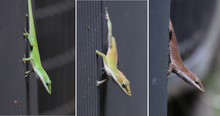
Some animals are capable of changing their colors with varying degrees of transformation. This may be a very gradual (shedding of fur or feathers) seasonal camouflage, occurring only twice a year. In other animals more rapid changes may be a form of active camouflage, or of signalling.
Examples [edit]
Examples of animals that modify colour include:
Mammals and birds [edit]
- Alaskan hare - In the summertime, Alaskan hares have a brown fur glaze with white under parts. In the winter, they have a white fur coat with black-tipped ears. They also shed their gray-brown summer topcoat, becoming all white during the winter.[1]
- Arctic hare - In Newfoundland and southern Labrador, the Arctic hare changes its coat color, moulting and growing new fur, from brownish or gray in the summer to white in the winter, similar another Arctic animals including ermine and ptarmigan, enabling it to remain camouflaged as the environment changes.[2] Yet, the Chill hares in the far north of Canada, where summer is very curt, remain white all year circular.[2]
- Chill pull a fast one on
- Stone ptarmigan
- Willow ptarmigan
- Snowshoe hare
- Stoat
Reptiles and amphibians [edit]
- Chameleons - Colour change signals a chameleon'southward physiological condition and intentions to other chameleons.[3] [4] Because chameleons are ectothermic, they alter color also to regulate their torso temperatures, either to a darker color to absorb low-cal and heat to raise their temperature, or to a lighter color to reflect lite and heat, thereby either stabilizing or lowering their body temperature.[5]
- Anoles - The majority of anoles (Dactyloidae) tin change their colour depending on things like emotions (for example, aggression or stress), activity level, levels of light and as a social betoken (for example, displaying authorisation).
- Frogs due east.m. Gray treefrog and Peron's tree frog (which can change color in less than 1 hr).
Molluscs [edit]
- Cephalopod - Cephalopods can change their colors and patterns in milliseconds, whether for signalling (both within the species and for warning) or active cover-up, every bit their chromatophores are expanded or contracted.[6] Although color changes appear to rely primarily on vision input, there is bear witness that skin cells, specifically chromatophores, can notice light and accommodate to light weather condition independently of the optics.[vii]
- Cuttlefish including Sepia prashadi
- Octopus including Mimic octopus and Giant Pacific octopus
Fish [edit]
- Many fish change colors, including several species of gobies and groupers. Color changes may exist initiated by changes in mood, temperature, and stress in improver to visible changes in the local environment.
- Flounder e.k. Hippoglossina oblonga
- Syngnathidae (including seahorses)
Insects and spiders [edit]
- Charidotella sexpunctata - Adults can turn from shiny gilt through reddish-brown when disturbed.[8]
- Misumena vatia - The color change from white to xanthous (depending on the colour of the flowers on which the spider is hunting) takes between 10 and 25 days; the contrary about vi days.
- Chrysso venusta has been observed to speedily change its color when disturbed.
- Some spiders, including Cyrtophora cicatrosa, tin can alter colour apace.[9]
- Thomisus spectabilis
See also [edit]
- Bioluminescence
- Peppered moth evolution - an example of color modify during evolution
References [edit]
- ^ DeBruine, Lisa. "Lepus othus Alaskan hare". Animal Diversity Web. Retrieved i March 2013.
- ^ a b "Arctic Wild animals". Churchill Polar Bears. 2011. Retrieved January thirty, 2012.
- ^ Stuart-Fox, D.; Moussalli, A. (2008). "Selection for Social Signalling Drives the Evolution of Chameleon Colour Modify". PLOS Biological science. 6 (ane): e25. doi:ten.1371/journal.pbio.0060025. PMC2214820. PMID 18232740.
- ^ Harris, Tom (18 May 2001). "How Animal Camouflage Works". How Stuff Works. Retrieved 2006-11-xiii .
- ^ Melt, Maria. "The Adaptations of Chameleons". Sciencing . Retrieved 15 June 2020.
- ^ "integument (mollusks)."Encyclopædia Britannica. 2009. Encyclopædia Britannica 2006 Ultimate Reference Suite DVD
- ^ Ramirez, M. D.; Oakley, T. H (2015). "Heart-independent, calorie-free-activated chromatophore expansion (LACE) and expression of phototransduction genes in the peel of Octopus bimaculoides" (PDF). Journal of Experimental Biology. 218 (10): 1513–1520. doi:10.1242/jeb.110908. PMC4448664. PMID 25994633.
- ^ Murray, T. Golden Tortoise Beetle. Archived 2009-01-07 at the Wayback Motorcar Garden Friends and Foes. Washington State University, Whatcom County Extension.
- ^ "Spider Environmental". Globe-Life Web Productions. 31 May 2020.
Source: https://en.wikipedia.org/wiki/List_of_animals_that_can_change_color
Posted by: hambywherfust.blogspot.com
0 Response to "What Animals Change Color In The Winter"
Post a Comment