

What Animals Would Have Been Around Jesus In The Manger
A crib without ox and ass would be incomplete: the 2 animals, together with the main characters Mary, Joseph and the baby Jesus, simply belong to a traditional crib. Simply how did the ox and donkey, which are amidst the oldest Christian motifs, enter the stable? And what is the meaning of the other animals in the stable?
When do the ox and the donkey appear in depictions of the birth of Jesus?
The ox and the ass accept been an indispensable part of pictorial representations of the nascency of Jesus since the time of early on Christianity. In addition to the nativity figures likewise appear in medieval frescoes or in church windows from the 4th century onwards - before then, the Roman oppression of Christians left no chance for Christmas fine art or the christian symbols such as the donkey and the ox.
However: the animals that witnessed the nascency of Jesus exercise not appear in the Bible. In the Gospel of Luke, which tells us the story of Christmas, there is only mention of a crib stable and a manger in which the newborn babe is placed, but not animals.
What is the importance of the ox and the donkey in the stable?
Some historians believe that the ox and the donkey in the hut refer to the Old Testament. From the verse of the prophet Isaiah.
"The ox knows its owner and the donkey its master'due south manger; Israel has no knowledge, my people have no understanding" (Isa 1: ii-3).
This sentence means: animals know where they belong. You are smarter than you might think. Take them as an case. At that time, the ox and the donkey were very important, as they served equally a livelihood and were indispensable tools for field work. The animals in the hut, the ox and the donkey, are very shut to the message of the Incarnation of God. The shepherds and the The 3 wise Kings will come afterwards.
This estimation is too supported past the representation on the sarcophagus of the city gate in the Church of Sant'Ambrogio in Milan (made effectually 380-400 AD) - also known as the 'Sarcophagus of Stilicho'. Hither Jesus lies all lonely in the manger, without Mary and Joseph - merely flanked by an ox and a donkey. And in the counterfeit infancy gospel of Pseudo-Matthew it says: "On the third 24-hour interval of the nascence of our Lord Jesus Christ, the blessed virgin came out of the cave, went into the stable, and laid her boy, whom the ox and the donkey worshipped, in a manger Even the animals, ox and ass, among whom he lay, worshipped him unceasingly".
Furthermore, a poesy from the book of the Habakuk prophets refers to the two animals in the stable. The Greek translation reads: "Lord, I heard your news and was in awe, Lord, I looked at your works and was impressed. Yous are acknowledged in the midst of two living creatures ..." (Habakuk three: 2). Co-ordinate to the Christian conception, the donkey at the manger represents the pagans, the ox the Jews.
Which animals are still in the stable
Likewise the ox and the donkey, we often discover other animals in the stable, for example sheep and lambs, dogs but also camels, elephants and horses. What do these mean?
Sheep and lambs
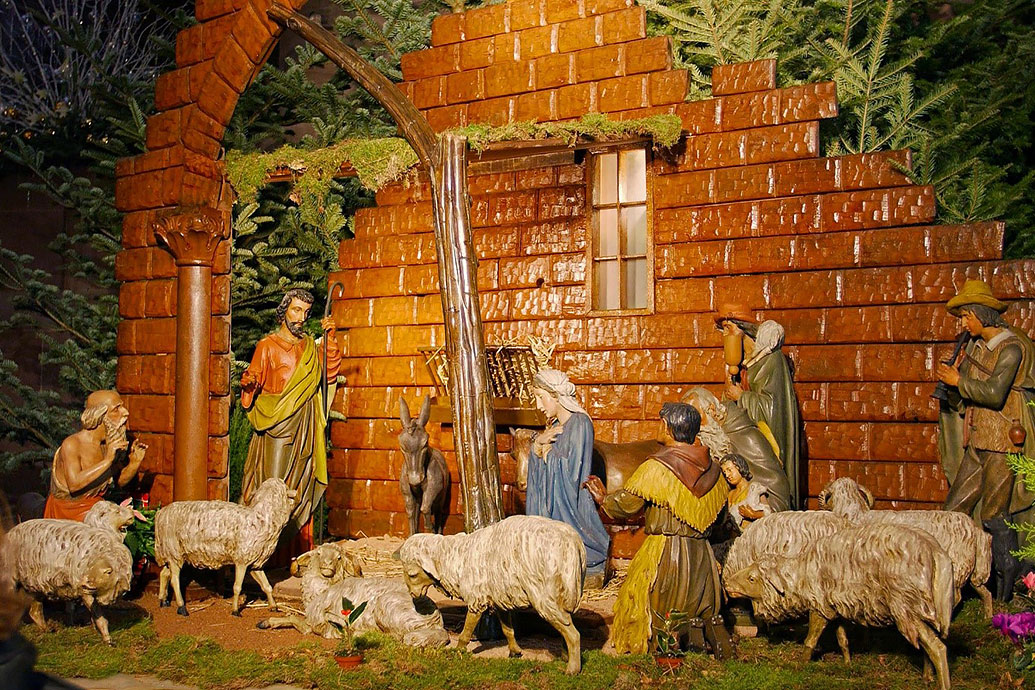 The shepherds came with their flocks of sheep to the stable to witness the birth of Jesus.
Sheep are the animals most often mentioned in the Bible. At that fourth dimension they were not considered stupid animals only useful. In both the Sometime and New Testaments at that place are numerous references to sheep or lambs. While the Old Testament deals with the sacrificial lamb, the New Testament symbolises sheep for the misguided homo who is brought dorsum to the right path by the shepherd Jesus.
Shepherds and their 'flocks' are also mentioned in the Christmas story according to Luke. They were the shepherds, the first to hear the good news of Jesus birth through an affections. They hurried to the stable, together with the animals for which they were responsible. In the Bible it says:
"In that region the shepherds camped in the open up field and kept watch over their flock at night. The angel of the Lord approached, and the glory of the Lord shone around them". (LK 2,8-12)
Even if the sheep are only marginal figures in the Christmas crib, they still help to bring the Christmas story closer to people.
Sheepdogs
In many cases, a canis familiaris also joins the oversupply of animals in the hut. It is the canis familiaris of the flock of sheep and the shepherd and is a symbol of vigilance and protection. In some nativity scenes there are ofttimes many other animal figures. This shows that at Christmas the whole of God'due south cosmos is considered, not simply the human world but too the animal world.
Camel, elephant and horse
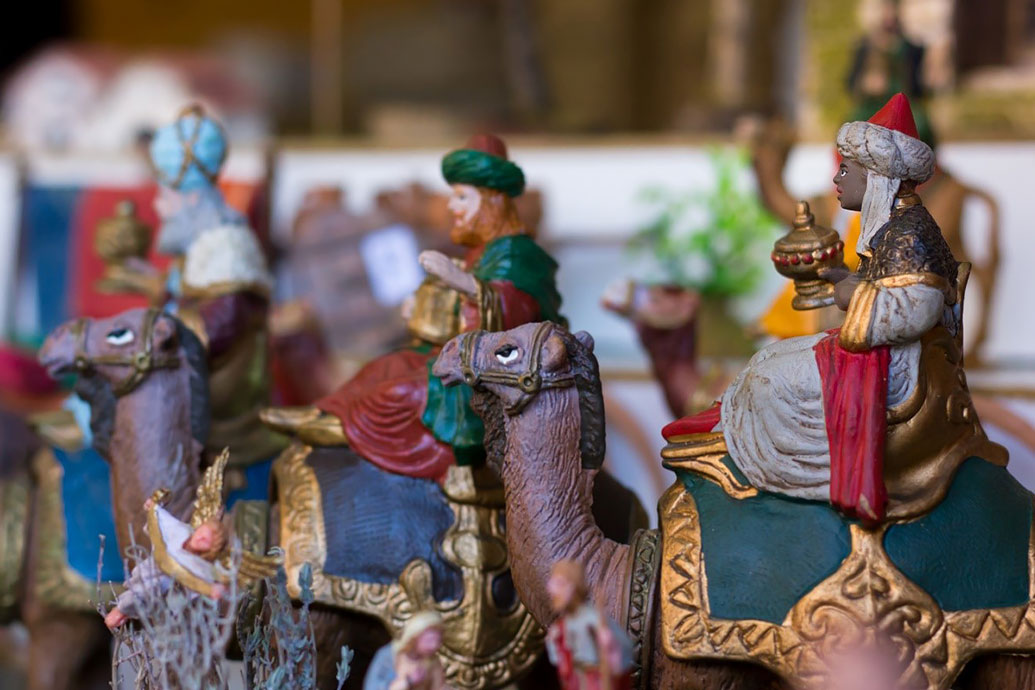 From Epiphany onwards, exotic animals such as camels also enrich the crib.
Besides the ox and the ass, the sheep and lambs and the sheepdog, in some nascence scenes one can besides see exotic animals, such every bit an elephant and a camel and at to the lowest degree one horse. The three saddle animals belonged to the three wise men from the Due east. They represented the continents known at the fourth dimension: the elephant, which is usually placed next to the night-skinned Rex Gaspar, represents the African continent; King Balthazar rides on a camel equally a representative of Asia and Melchior rides a horse as a representative of Europe.
Elephants and camels are elaborately designed nativity figures, but they can only enrich the birth scene at Epiphany.
Ox and ass - an integral part of every nascence scene
The figures of the Nativity leave a lot of room for estimation. This too applies to the animals, which are an essential part of every Christmas crib. In our magazine you will detect further informative articles on nativity scene figurines, for example on how to properly place nascence figures or their pregnant. We will also explain the history if the nativity scene. Feel free to browse our wide selection of handicrafts birth figures and Christmas Nascency sets in our online shop.
Credits: principal prototype: ©gettyimages/EnkiPhoto, image i: ©gettyimages/slowmotiongli, prototype two: ©gettyimages/JosuOzkaritz
Source: https://www.lignoma.com/en/magazine/why-are-ox-and-donkey-in-the-nativity/
Posted by: hambywherfust.blogspot.com
0 Response to "What Animals Would Have Been Around Jesus In The Manger"
Post a Comment